
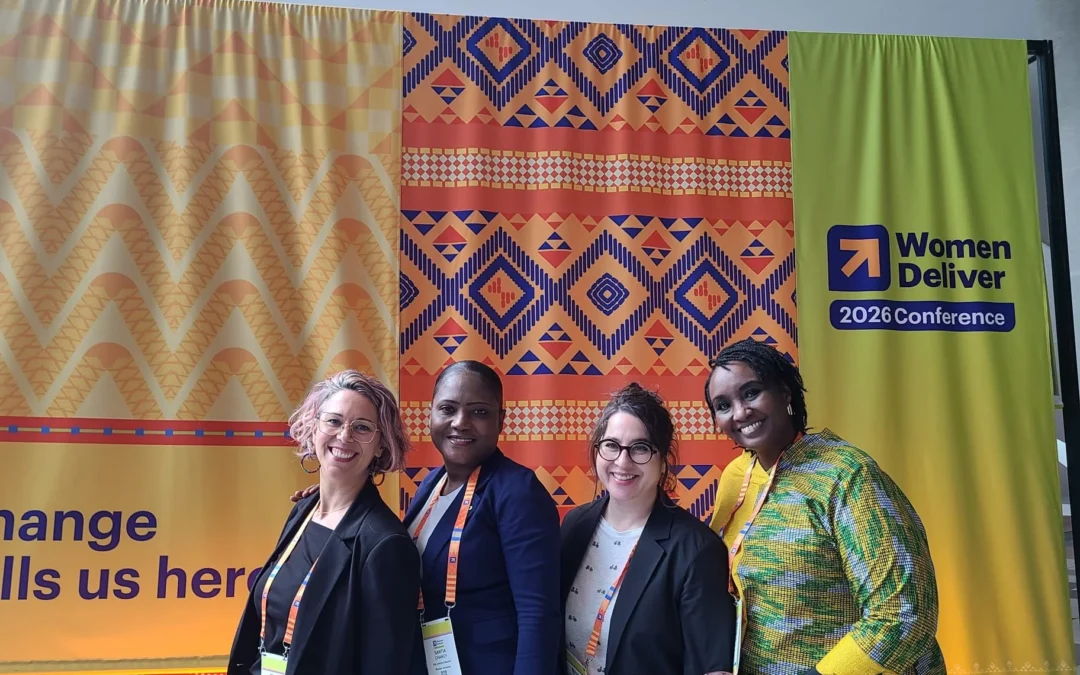
By Geneviève Gauthier, Senior Director, International Programs, and Coline Camier, Strategic Advisor, Gender and Social Inclusion.
From April 26 to 30, 2026, Melbourne hosted Women Deliver, the world’s largest gathering dedicated to the rights of women and girls. More than 6,000 people from 189 countries attended. Mission inclusion was there with a clear demand: that the leadership of feminist organizations in the Global South be funded directly and sustainably.
Our delegation took part in the Canadian roundtable organized by the Coalition canadienne pour la santé mondiale des femmes et des enfants (CanSFE). We also co-facilitated two concurrent sessions: the Feminist Triple Nexus Lab and the Climate Inclusion Workshop. These spaces highlighted innovative approaches developed through two projects led by Mission inclusion with the support of Global Affairs Canada (GAC): NexSa and ReSea.
Why This Demand, and Why Now
The underfunding of feminist organizations in the Global South is not an accident: it is a structural reality. Less than 1% of international aid reaches women’s organizations. Only 0.04% of global climate finance explicitly targets gender equality. These figures reveal a political choice: convening women from the Global South for discussions without transferring the resources they need to act.
In a global context where international law is flouted, where anti-rights movements are advancing, and where several major funders are pulling back, these gaps are becoming alarming. When Canada reaffirms its feminist commitment, coherence is measured concretely: in multi-year funding envelopes, in financing access mechanisms, in the duration of partnerships. This is the ground we occupied in Melbourne.
At the Canadian Roundtable: No Stepping Back
On April 26, on the sidelines of the conference, we joined the Canadian roundtable alongside Canada’s High Commissioner to Australia, Julie Sunday, GAC teams specializing in women’s health and gender equality, and several Canadian organizations. Discussions centred on sexual and reproductive health and rights (SRHR), as well as Canada’s role as a global leader on gender equality amid protracted crises.
As other funders withdraw, this leadership is not preserved through declarations: it is demonstrated by funding, sustainably and directly, the frontline organizations defending women’s rights. The true test of a feminist international aid policy is the coherence between its stated commitments and the budgets allocated to them.
At the Feminist Triple Nexus Lab: The Expertise Is Already There
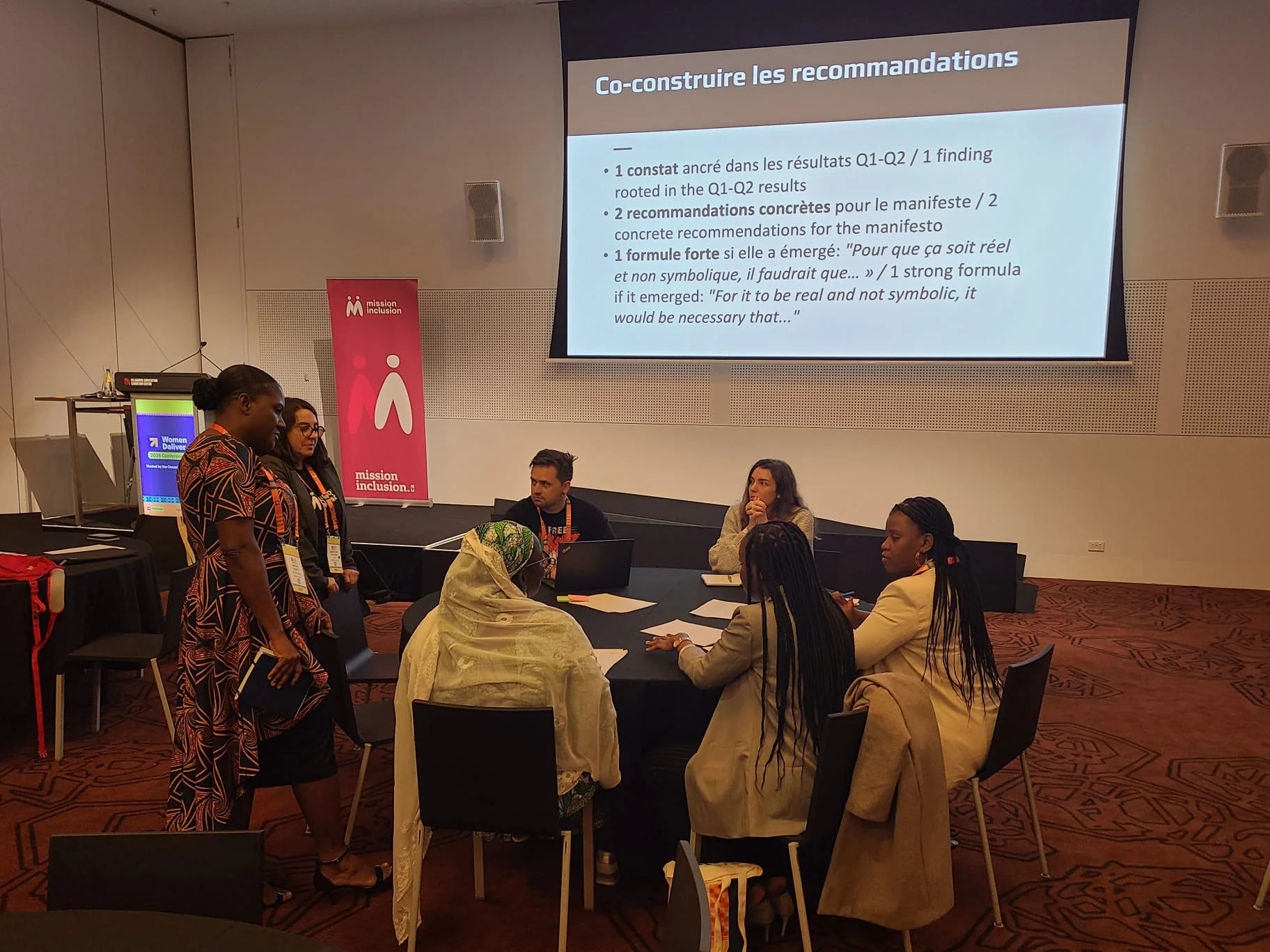
On April 28, Medjine Nestant, from Nègès Mawon, co-facilitated the Feminist Triple Nexus Lab with Santia Chancy and Geneviève Gauthier. The workshop deepened an innovative approach, the Feminist Triple Nexus, currently being implemented through the NexSa project, carried out in partnership with the Centre interdisciplinaire de développement international en santé (CIDIS) at Université de Sherbrooke, with GAC support.
The starting point: the situation of women and girls in Haiti. More than six million people are in urgent humanitarian need. Violence against displaced women and girls worsens as the crisis continues. Faced with this reality, Haitian feminist organizations like Nègès Mawon respond to emergencies while defending rights, because the situation does not allow them to separate these two missions.
The Triple Nexus approach, which links humanitarian assistance, development, and peacebuilding, was not invented by funders or by organizations from the Global North. It has long been practised by feminist organizations working in protracted crisis contexts, which cannot afford to silo their interventions. NexSa is Mission inclusion’s commitment to implement this approach with its partners in Haiti and Cameroon, and to bring their analyses into the spaces where we have access.
During the workshop, participants reflected in groups on three questions: what is most often ignored in the lives of women in crisis, what priority change is needed for truly transformative nexus action, and what conditions are necessary for that change to be real rather than symbolic. The commitments and recommendations that emerged will inform the next phase of the NexSa project and Mission inclusion’s advocacy with funders.
“Feminist organizations in the Global South are not beneficiaries. They are the experts of the crises they live.”
At the Climate Inclusion Workshop: Beyond the Symbolic
On April 30, Rose Marandu, from Women Fund Tanzania Trust (WFT-T), co-facilitated the Climate Inclusion Workshop with Perpetua Angima and Coline Camier. Working groups explored the six dimensions of climate inclusion advanced by Mission inclusion: access to information, recognition of local and Indigenous knowledge, participation in decision-making, leadership, financing, and enabling conditions.
The workshop drew on the experience of the ReSea program, carried out with GROOTS Kenya and Women Fund Tanzania Trust, and on the role of women in managing natural resources in the western Indian Ocean. The session closed with a screening of an excerpt from the short film Amkeni, a documentary following women in Kilifi County, Kenya, in their work restoring mangroves and developing beekeeping enterprises.
The climate inclusion framework we advance serves to make visible a gap: the one between inclusion proclaimed in declarations and inclusion actually experienced by women in coastal communities. Participating in an international meeting means occupying a seat in a room. Meaningful participation is something else: receiving information in a timely manner, having one’s knowledge recognized as expertise, influencing decisions, accessing financing, and exercising leadership in safety.
“As long as climate finance and governance systems do not change, inclusion will remain symbolic.”
What We Bring Back to Montreal
Three sessions, one conviction. Feminist organizations in the Global South are on the frontlines, on health, on the rights of women, girls, and people of diverse sexual orientations and gender identities, on peace, and on climate. International solidarity means funding their work, sustainably and on terms they can carry.
For Mission inclusion, this translates into two concrete commitments: NexSa and ReSea. And into sustained advocacy with the Government of Canada to ensure its feminist international aid policy translates into real budgets.
What Comes Next
NexSa continues its work with partners in Haiti and Cameroon. ReSea continues with partners in Kenya, Tanzania, Mozambique, Madagascar, and the Comoros. This autumn, Mission inclusion will bring climate inclusion and the Feminist Triple Nexus to COP31, to be held from November 9 to 20, 2026, in Antalya.