
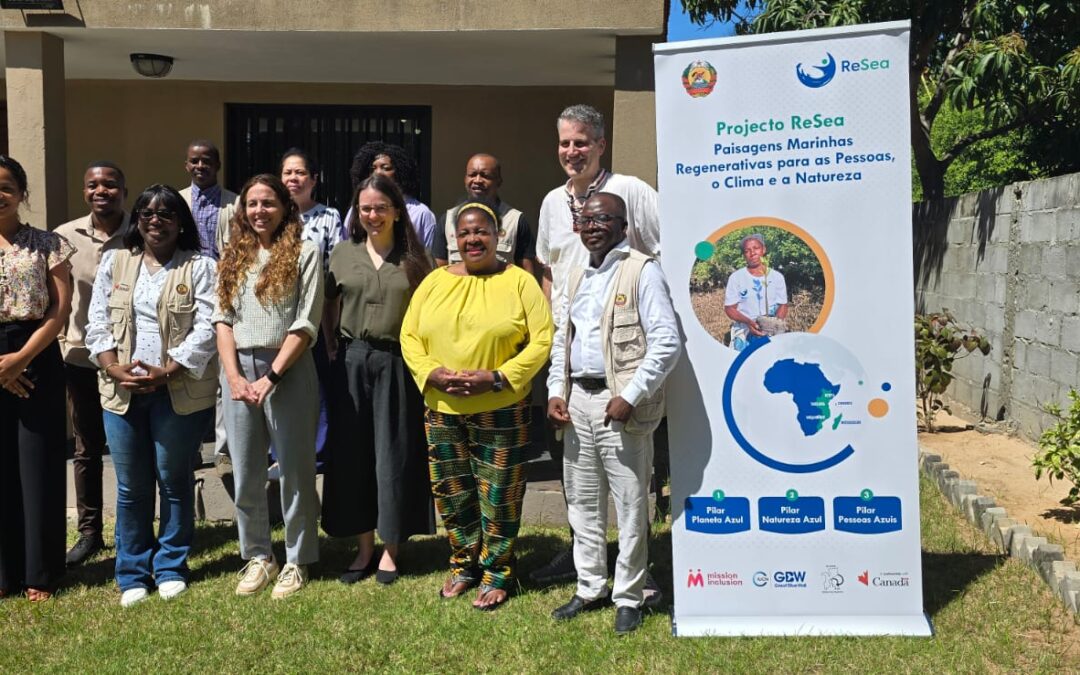
Inhambane Province, Mozambique, March 2026 – The Regenerative Seascapes for People, Climate and Nature (ReSea) Project is hosting a delegation from Canada including a representative of Global Affairs Canada in Inhambane Province, Mozambique, to witness firsthand how coastal communities led by women and youth are driving climate adaptation and building resilient ocean-based livelihoods under the ReSea Project.
The ReSea Project is enhancing the physical, social and economic resilience of coastal communities in Vilankulo and Inhassoro, in the face of the effects of extreme climate events . The project champions sustainable and inclusive coastal and marine resource management through inclusive governance, gender‑responsive climate adaptation solutions, and a regenerative blue economy. ReSea works particularly with women and youth, empowering them to become active members of coastal governance structures such as Community Fisheries Council (CFCs), ensuring that climate adaptation strategies address their needs, and providing skills training to help them scale their nature‑based blue economy enterprises.
In Mozambique, the project is led by Mission inclusion, the International Union for Conservation of Nature (IUCN) and MULEIDE. During the visit, the Canadian delegation is engaging with government authorities, community leaders, academia, women groups, private sector actors, and local organizations to assess progress in restoration of coastal ecosystems (including mangroves, dunes, and seagrasses), women participation and inclusion in ocean governance, and entrepreneurship in a regenerative blue economy.
The delegation will also observe on‑the‑ground interventions and see how communities actively participate in the sustainable management of natural resources. A highlight of the visit includes meeting with groups of women entrepreneurs supported by the project, who are active in blue economy value chains such as fish processing and marketing.
“Canada is proud to support the ReSea Project. What we are seeing in Mozambique is the gradual development of blue economy value chains driven by collaboration between communities, public authorities, and local partners, with tangible benefits for livelihoods, ecosystems, and climate resilience,” said Michel Marleau, Senior Program Officer (Climate), Environment and Climate Action Partnerships, Global Affairs Canada.
“The work carried out in the seascape of Inhambane is a testament to what coastal communities can achieve when they take the lead in their own climate adaptation,” said Andréanne Martel, Project Director at Mission inclusion. “With support from the Government of Canada, through the Partnering for Climate program, communities have built inclusive governance structures, restored coastal ecosystems, and launched women-led businesses. As ReSea enters its final year, our focus, together with IUCN and MULEIDE, is to ensure that these results continue to grow. What women and young people have built here is a proven model for climate resilience that can inspire coastal communities across the region.”
Tara Pelembe, Interim Country Representative, IUCN Mozambique, remarked, “The ReSea Project has a rich and diverse network of stakeholders who are coming together to build a regenerative marine landscape in Inhambane Province. It is an innovative approach that brings together conservation and development with gender equality and Nature-based Solutions at its core. This week, we welcome Mission inclusion and the Government of Canada to the marine landscape to meet with stakeholders and hear from them about how the project is transformative in these and other areas.”
“In Vilankulo and Inhassoro, our partnership with the Government of Canada is turning climate resilience into community reality,” said Rafa Valente Machava, Executive Director, MULEIDE, “securing a sustainable future for our communities.”
About the ReSea Project
The Regenerative Seascapes for People, Climate and Nature (ReSea) Project is a four‑year initiative (2023–2027) funded by the Government of Canada through the Partnering for Climate program.
Implemented in five African countries, ReSea works with local communities, civil society, and government partners to restore marine ecosystems, build climate resilience, and create sustainable blue economy opportunities, with a strong focus on gender equality and social inclusion.

“Canada is proud to support the ReSea Project. What we are seeing in Mozambique is the gradual development of blue economy value chains driven by collaboration between communities, public authorities, and local partners, with tangible benefits for livelihoods, ecosystems, and climate resilience,” said Michel Marleau, Senior Program Officer (Climate), Environment and Climate Action Partnerships, Global Affairs Canada.
“The work carried out in the seascape of Inhambane is a testament to what coastal communities can achieve when they take the lead in their own climate adaptation,” said Andréanne Martel, Project Director at Mission inclusion. “With support from the Government of Canada, through the Partnering for Climate program, communities have built inclusive governance structures, restored coastal ecosystems, and launched women-led businesses. As ReSea enters its final year, our focus, together with IUCN and MULEIDE, is to ensure that these results continue to grow. What women and young people have built here is a proven model for climate resilience that can inspire coastal communities across the region.”
Tara Pelembe, Interim Country Representative, IUCN Mozambique, remarked, “The ReSea Project has a rich and diverse network of stakeholders who are coming together to build a regenerative marine landscape in Inhambane Province. It is an innovative approach that brings together conservation and development with gender equality and Nature-based Solutions at its core. This week, we welcome Mission inclusion and the Government of Canada to the marine landscape to meet with stakeholders and hear from them about how the project is transformative in these and other areas.”
“In Vilankulo and Inhassoro, our partnership with the Government of Canada is turning climate resilience into community reality,” said Rafa Valente Machava, Executive Director, MULEIDE, “securing a sustainable future for our communities.”
The Regenerative Seascapes for People, Climate and Nature (ReSea) Project is a four‑year initiative (2023–2027) funded by the Government of Canada through the Partnering for Climate program.
Implemented in five African countries, ReSea works with local communities, civil society, and government partners to restore marine ecosystems, build climate resilience, and create sustainable blue economy opportunities, with a strong focus on gender equality and social inclusion.
Suivez-nous sur les réseaux sociaux ou abonnez-vous à notre infolettre pour les dernières nouvelles sur Mission inclusion.