
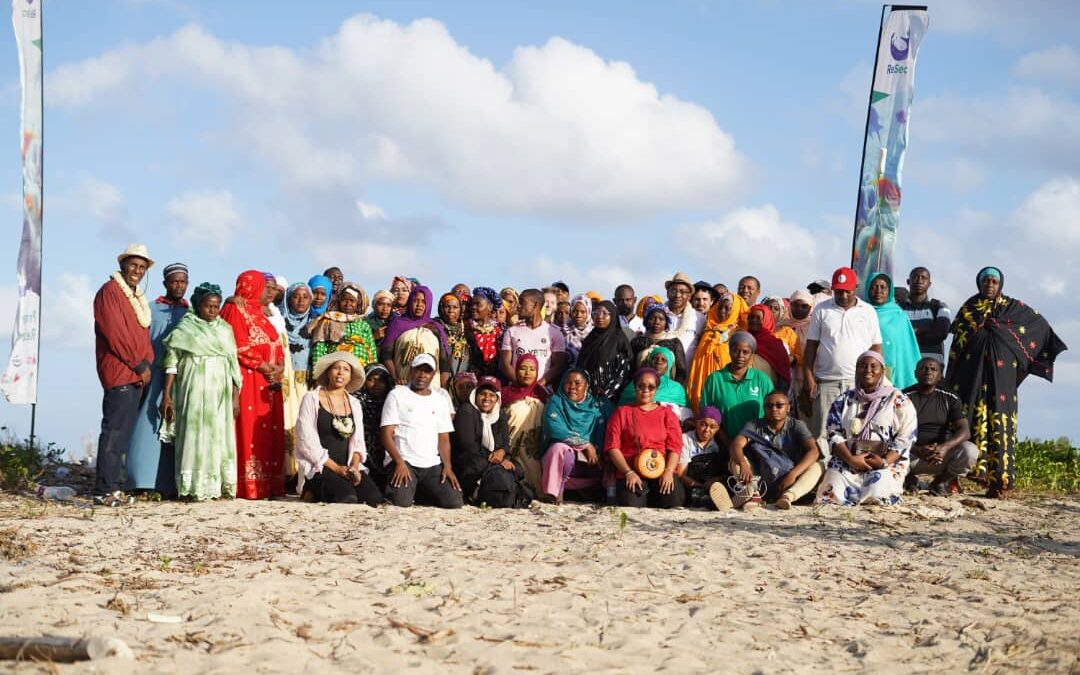
In September 2025, Moheli, Comoros hosted the ReSea (Regenerative Seascapes for people and nature) project’s 2nd week of gender-responsive Nature-based Solutions for Adaptation (NbSA) Training.
Building upon the trainings in 2024, this 2025 edition brought together government representatives, women’s groups, youth, private sector actors, and conservation leaders. Held in the UNESCO Biosphere Reserve of Moheli, the workshop marked a milestone for Comoros in advancing gender-responsive climate adaptation actions.
A collaborative training effort
The training was led by IUCN Eastern and Southern Africa’s Loubna Hamidi, Denise Nicolau, Said Ahamada and IUCN Climate Change & Energy Transition Team, represented by Zoe Jafflin. Together with PFDDSA’s Dini Hamada, Mohamed Mohamed Cheik, Rahamata Maambadi, Zarna Anasse, and Zalihata Bounou, this training equipped participants with the skills to design and implement gender-responsive NbSA, while underscoring the need to integrate them into national and local climate strategies.
The training forms part of the ReSea Project, implemented by Mission inclusion, IUCN, and PFDDSA, with the support of Global Affairs Canada (GAC), and contributes to the African-led Great Blue Wall Initiative. ReSea is also part of the Partnering for Climate, a $315 million initiative from GAC with the goal of promoting gender-responsive NbS for climate change adaptation with biodiversity co-benefits.
From concept to practice
Over five days, sessions explored key thematic areas that are essential for effective and long-term NbSA. From concept to practice, the training prioritized the practical elements that practitioners and policymakers need to support NbSA projects, such as the various financing mechanisms that enable local action from the ground-up.
Utilising NAbSA’s Operational Framework, participants – simulating real NbS scenarios in the Moheli context – worked together to construct an NbSA project from start to finish. This included economic evaluations of interventions, Theories of Change, Monitoring, Evaluation and Learning (MEL) plans, Gender and Social Inclusion (GESI) strategies, co-management plans, and communications strategies.
Sparking immediate community action
More than a learning space, the training sparked immediate community action: Ms. Hadidja Ali Houmadi, President of Ulanga Mwema in Nioumachioi, announced that her women’s group will launch a mangrove clean-up campaign with the Fund for Sustainable Development (FSSD) and ReSea women influencers.
The call for mainstreaming NbS was clear. “From today onwards, every environmental action plan, strategy, and management plan inside Moheli National Park must integrate NbS actions,” stressed Mr. Kassimou Attoumani, President of the Moheli National Park Steering Committee.
Echoing this, Mr. Mouktafi Said Ramadan L, Regional Director for Environment and Forest, emphasized: “We have raised knowledge about NbS, but it is everyone’s responsibility to implement them in their sites. This collective responsibility is critical for success.”
A milestone for transformative climate action
By combining science, community leadership, and gender-responsive approaches, the Moheli training set the stage for transformative climate action in Moheli, anchoring NbS at the heart of the nation’s journey toward resilience and sustainable development. A journey that will contribute not only to local change, but also to the Partnering for Climate portfolio—amplifying Moheli’s experience as part of a global movement advancing Nature-based solutions for climate adaptation.
Follow us on social networks or subscribe to our newsletter for the latest Mission inclusion news.