
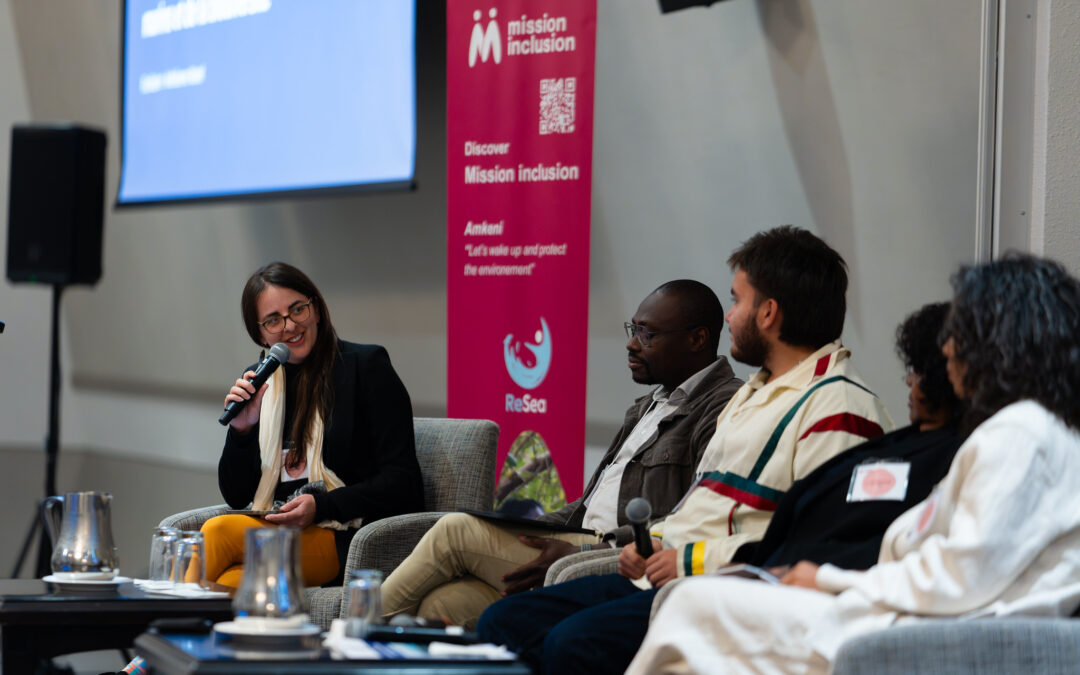
In Madagascar, a fishing forum brings together 150 people. Among them, only three are women. How do we move from an almost symbolic presence to real decision-making power?
During the “Oceans of Transformation” week in Montreal, seven women leaders from Kenya, Tanzania, Mozambique, and Madagascar shared their answers to this question. Women elected to head governance bodies, communities making their voices heard, teams learning to listen differently.
Their experiences show how climate inclusion takes shape when women and communities can genuinely influence the decisions that affect their future.
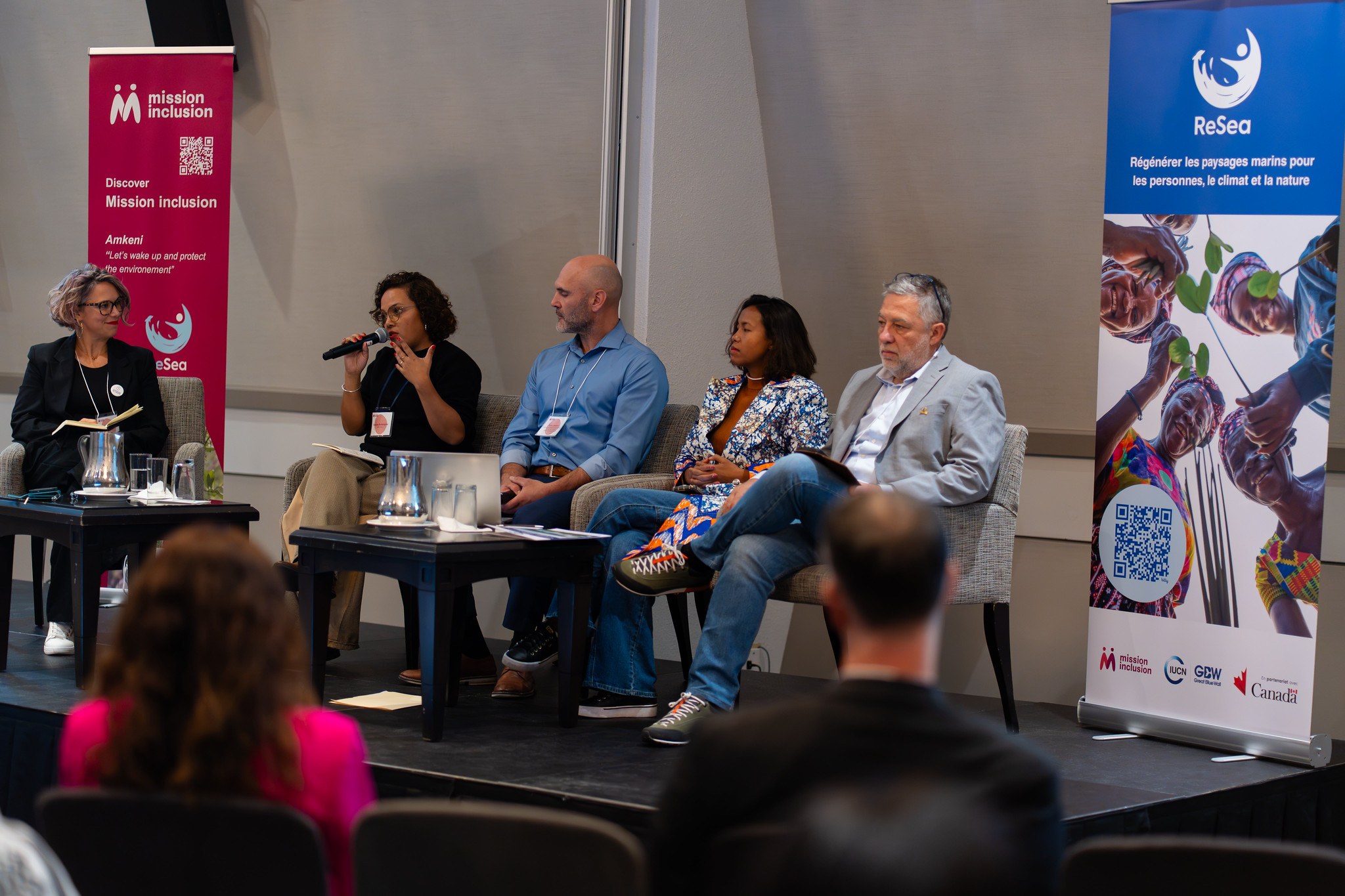
Oceans of Transformation: Voices from the Field in Montreal
From October 19 to 22, 2026, Mission inclusion celebrated the progress of the ReSea project during the “Oceans of Transformation” week in Montreal.
Implemented by Mission inclusion in partnership with the International Union for Conservation of Nature (IUCN), and supported by the Government of Canada, ReSea operates in five countries of the Western Indian Ocean: Kenya, Tanzania, Mozambique, Madagascar, and the Comoros.
The results reflect the work accomplished across the project’s five marine landscapes:
 71,078 people directly reached, 45% of whom are women and 30% youth. 41,700 km² of marine landscapes now under management, conservation, and restoration.
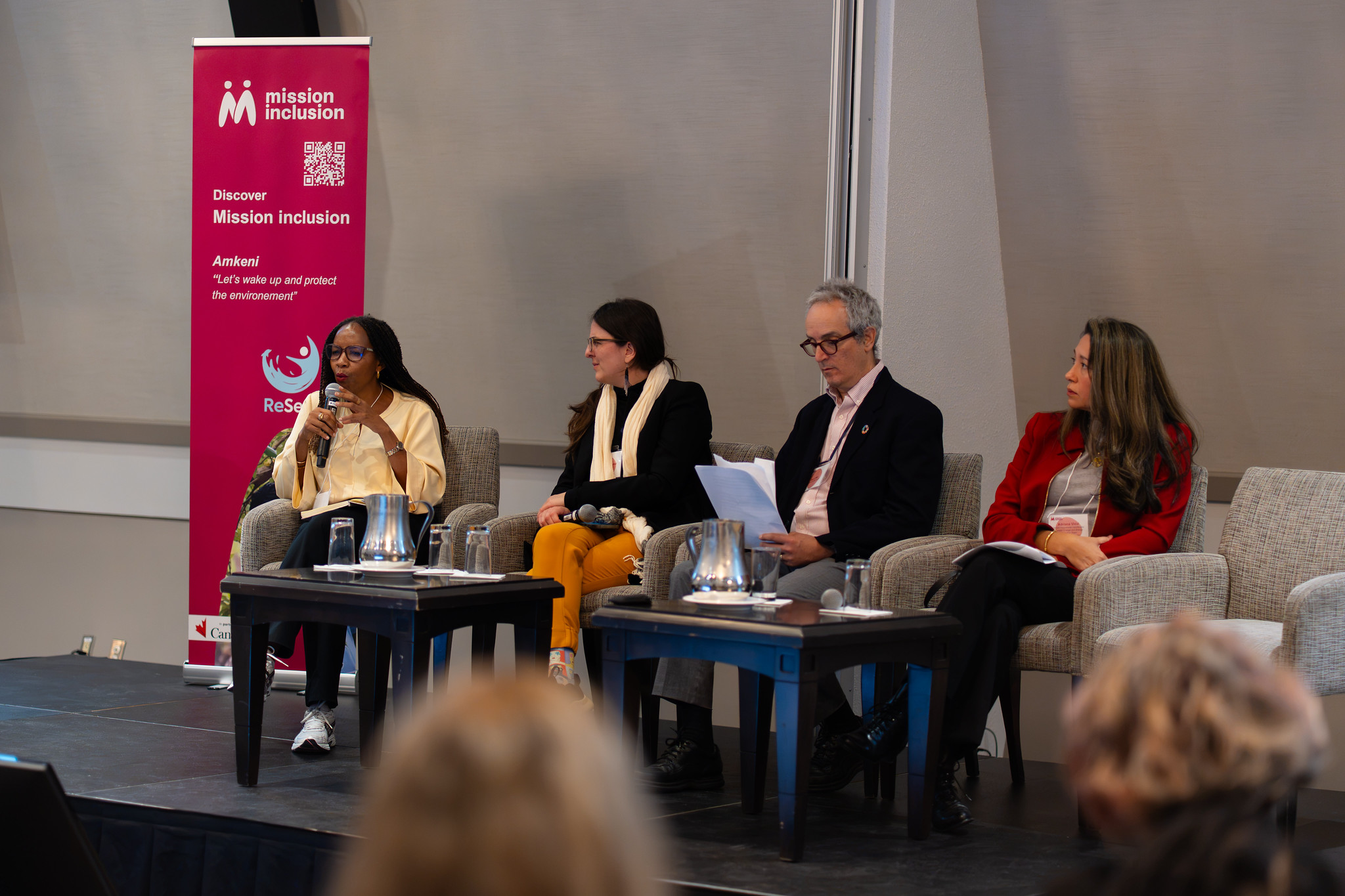
On Monday, October 19, at the Centre Mont-Royal, the symposium “Acting for Inclusive Climate Adaptation” brought together the delegation of seven women leaders to discuss feminist approaches, indigenous and local knowledge, inclusive governance of marine protected areas, nature-based solutions, and inclusive coastal value chains.
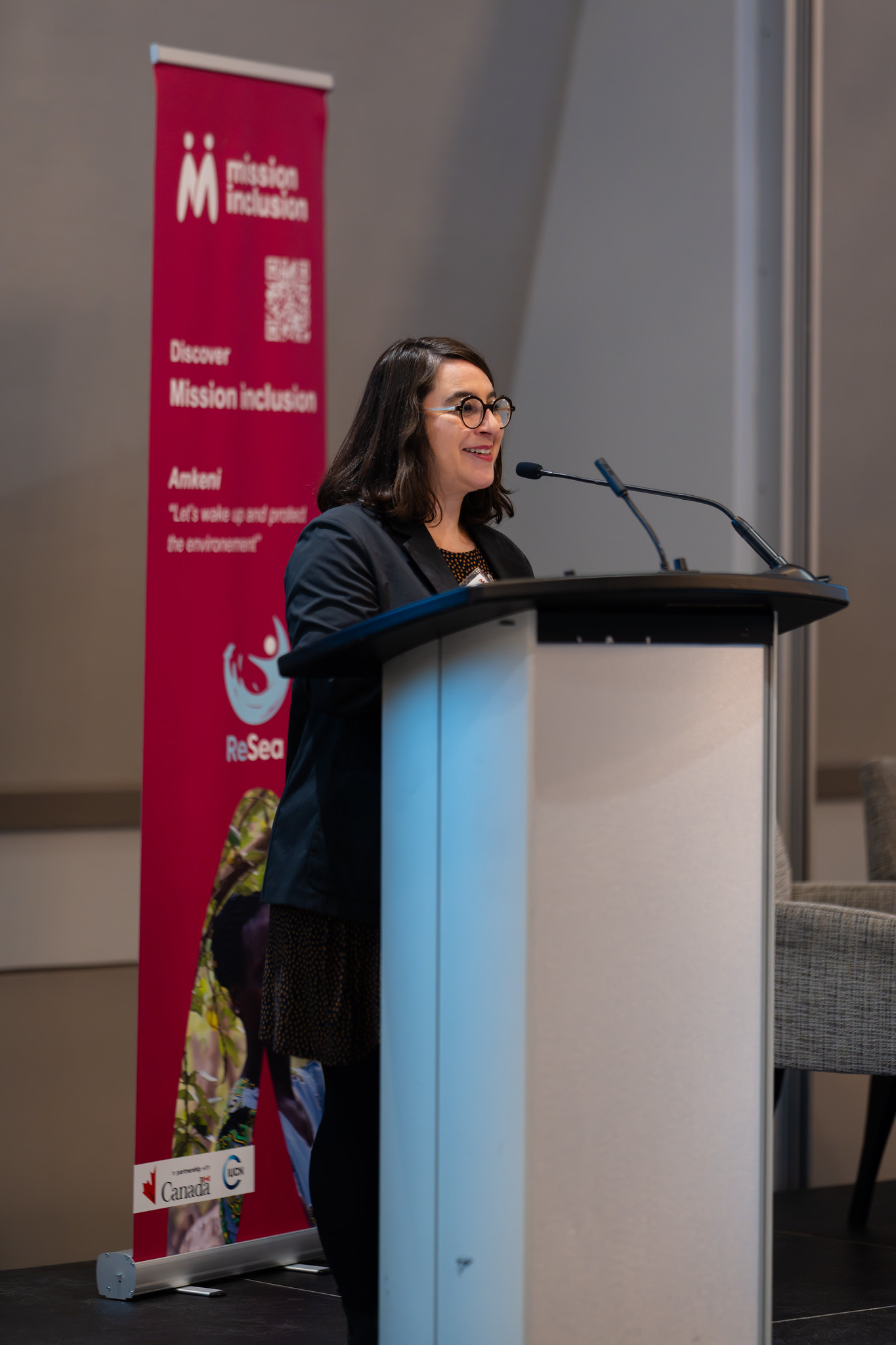
From the opening remarks, Geneviève Gauthier of Mission inclusion, who hosted the day, highlighted the stakes:
“Adaptation works when it relies on the agency of everyone, including women and youth, who are still too often excluded from the decisions that nevertheless affect them first.”
Geneviève Gauthier, Mission inclusion
Climate Inclusion Begins with a Question: Who Can Participate?
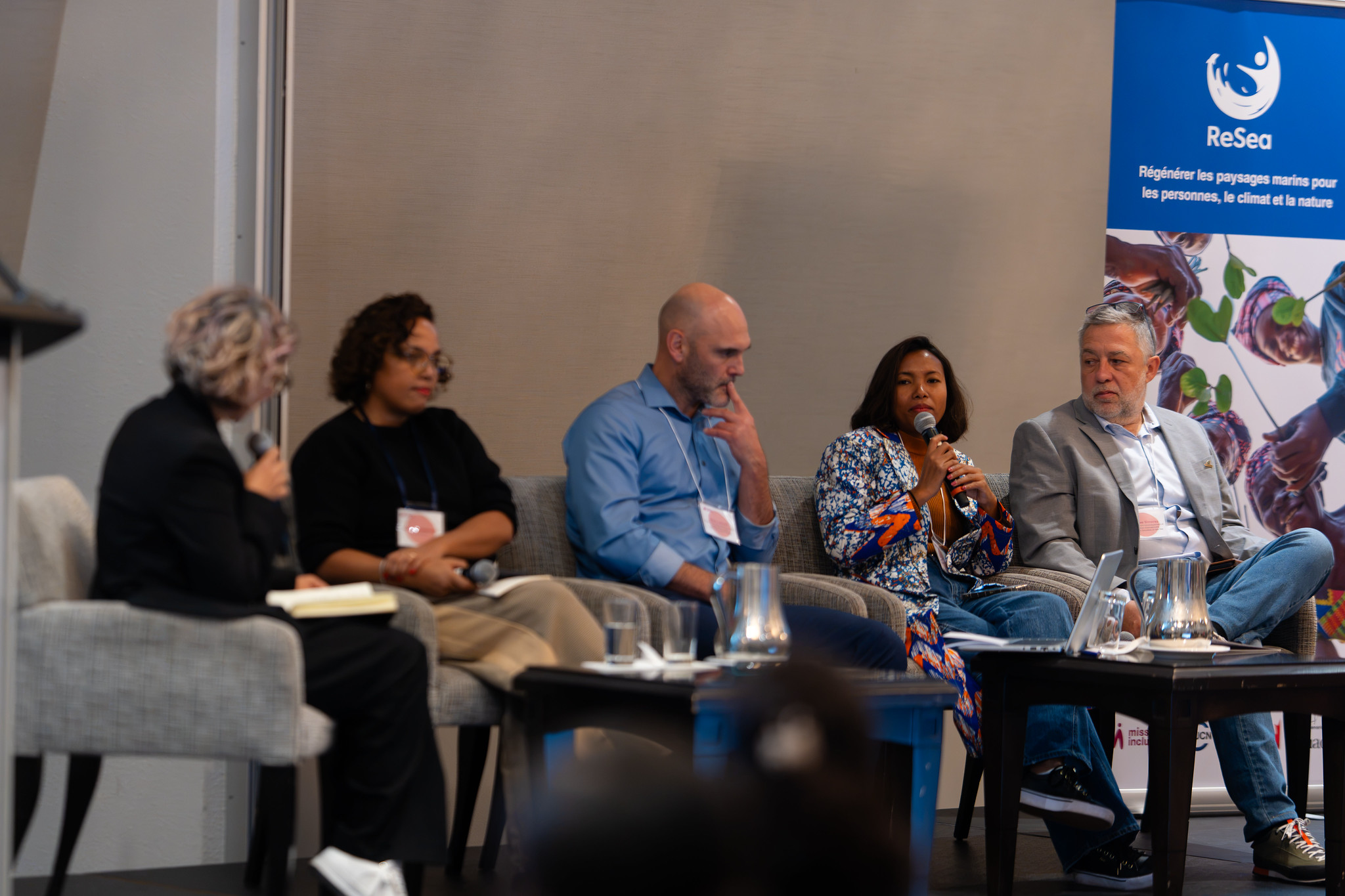
Vatosoa Rakotondrazafy from the IUCN worked for an alliance of small-scale fishers in Madagascar. At the symposium, she shared how this network sought to amplify the voices of communities, especially women.
“We created this network precisely to strengthen the voice of these communities. And it was through this network, for example, that we were able to create a leadership program to strengthen women’s voices, because when we organized fisher forums, we would have 150 participants, and only three women among them. It was really just a physical presence. So that’s why, through this program, we managed to reach, I think, 45% female participation in this network. Women have started being elected as presidents of associations.”
Vatosoa Rakotondrazafy, IUCN (Madagascar)
Going from three women out of 150 people to around 45% female participation in the network represents a tangible shift. Even more so, women are now stepping into leadership roles as association presidents.
For Andréanne Martel, ReSea Project Director at Mission inclusion, this distinction between presence and influence is fundamental. Active participation is one of the four core elements of ReSea’s feminist approach.
“It is not about having women and youth at the table; it is about creating the means for them to truly influence and participate. Sometimes, this means building their capacities, expanding their knowledge, and valuing their existing, experiential knowledge.”
Andréanne Martel, ReSea Project Director, Mission inclusion
However, barriers to participation can hide in seemingly trivial details.
Rose Marandu, Executive Director of the Women Fund Tanzania Trust, a Tanzanian feminist organization, provided an example: the timing of a meeting can determine who attends. Some women are already at the market, while others are at health centers.
Behind this scheduling question lies a governance issue.
“Can we ensure that leadership is also held by women? Because when you are a leader, you have authority, and you make decisions. And this authority is essential for how resources are distributed—productive resources—so that women can achieve their own dreams. If we truly want adaptation, if we truly want to bring change, power, and authority to women, then we really need to adapt. This is what we are talking about: the voice, participation, and leadership of women, which must be respected. And what we call logistics are actually governance issues. When are decisions being made?”
Rose Marandu, Women Fund Tanzania Trust (Tanzania)
When Women Organize, Their Voices Carry Further
Taking your place in decision-making sometimes requires coming together to be heard.
Vatosoa Rakotondrazafy illustrated this with an image from her experience with the fishers’ alliance:
“Working through the network makes us better heard and better respected, especially at the government level, because when they gather, it’s like fish: instead of being a single fish in the sea, if you gather, there is more strength.”
Vatosoa Rakotondrazafy, IUCN (Madagascar)
This collective strength opens doors to new political and community ambitions, supported by mentorship and training. The ReSea project actively builds capacities in leadership and governance across its marine landscapes.
“We have done a lot of this work through mentorship programs, through training […]. We bring the feminist movement together, we expose women to other women leaders so they can feel what leadership is like. And we have seen women go beyond their groups […]. They have now stepped out of them; they want to run for political office in the next elections.”
Rose Marandu, Women Fund Tanzania Trust (Tanzania)
The ReSea project is also supporting this rise in leadership across its five marine landscapes.
From the start of the project until the end of 2025, 1,568 people, including 87% women and 45% youth, strengthened their capacities in leadership, advocacy, organizational governance, and human rights.
This learning does not always stay in the training rooms. It can also translate into new candidacies, elections, and a different sharing of responsibilities.
From Training to Elections: Women Step into Power
In northern Madagascar, a woman became village chief after participating in rights-based training.
In this region where patriarchy is deeply entrenched, according to Sariaka Nantenaina from the organization CforC, this election marks a shift in community life.
“When we shared knowledge, when we shared information, it allowed women to be aware and to make decisions that affect their lives. […] Being a village chief in a place like this is truly a great victory and a big step forward where women can express themselves.”
Sariaka Nantenaina, CforC (Madagascar)
“Before, it was very categorized. Men did this, women did that. […] It still took years. […] It is truly the work of many years. Men are relinquishing power, sharing power, precisely to have this equitable community for greater production.”
Sariaka Nantenaina, CforC (Madagascar)
These changes take time. Some are now measured in the very composition of governance bodies.
In Tanzania, in Pangani Magharibi, women’s representation in the beach management unit—a community governance body—rose from 9 to 18 out of 25 members during the May 2025 elections. The new committee also includes 16 youth.
The ReSea project had conducted awareness and advocacy activities on inclusive governance there.
In Mozambique, the journey began with resistance.
Rafa Valente, from the feminist organization Muleide, a project partner, shared how her team addressed the concerns of men in the communities.
“It was very important for us to bring forward women’s voices. It was a difficult challenge: when we started, men challenged us, saying, ‘So, you only want to work with our sisters and our wives?’ […] We flipped the question back to them: what if we worked together, as a community?”
Rafa Valente, Muleide (Mozambique)
By focusing on dialogue with communities, traditional authorities, and government bodies, the team helped open up decision-making spaces previously reserved for men.
“We managed to establish a dialogue with government bodies and traditional authorities, and we also succeeded in bringing forward women’s voices. We managed to get five women elected to the highest decision-making bodies in fisheries. When we started the program, there were no women. […] And one of them now leads the community fisheries unit.”
Rafa Valente, Muleide (Mozambique)
Five women elected where none sat before. One of them now leads the community fisheries unit.
This work continues on the ground, as illustrated by the visit of a Canadian delegation to the marine landscape of Inhambane, Mozambique, in March 2026.
In the Comoros, the launch of the ReSea project in Mohéli also emphasized the role of local communities and feminist organizations in climate adaptation.
Being elected is one thing. Being able to decide is another.
Even when a body has a majority of women, power dynamics can still persist.
Magdalyne Were, from Mission inclusion Kenya, supports 45 blue economy enterprises across the project’s five countries, with a particular focus on women and youth.
In one of the groups supported by her team, women were in the majority. Yet, the men positioned themselves as advisors and continued to make the decisions.
The team then suggested reviewing the composition of the advisory body.
“For us, our role is to empower women and to reduce or, technically, remove the barriers that exist. What we were able to do was to request a new election of advisors within the group, so that the groups themselves could choose and balance their advisory body, allowing those who sit on it to decide on an equal footing who participates, who benefits, who is recognized, and how profits are shared within the group.”
Magdalyne Were, Mission inclusion Kenya
Who participates? Who benefits? Who receives recognition? And who decides how profits are shared?
These questions illustrate why climate inclusion must go further than just the number of women present.
They also invite project teams to rethink their own way of working.
Denise Nicolau, a marine ecologist at the IUCN and regional manager for ReSea’s nature-based solutions component, shared how her team had to change their approach.
“We wanted to deliver the framework, train people, and they would do the restoration. Beautiful, and easy. But life is not a straight line, is it? We had a moment where we had to step back and listen […]. Nature-based solutions is just an acronym, but people have been managing their resources for 10,000 years, I would say. They know what they have, they know the challenges they face. […] They know what they need. For this component, we learned more by listening to the communities and groups we worked with than the other way around. […] We have women influencers. They were part of the training component, and they are now the champions of nature-based solutions […].”
Denise Nicolau, UICN
Listening to the knowledge and experiences of communities changes the way interventions are designed.
This principle also applies to the relationships between international cooperation organizations and their partners.
Richard Veenstra, Director General of Mission inclusion, recalled that international cooperation has inherited a tradition sometimes marked by a savior complex, in relationships that were not always equal.
He expressed the desire to shift this stance:
“Today, our spirit, our will […] is to be a true partner in a common struggle and in a common commitment and for common benefits.”
Richard Veenstra, Director General, Mission inclusion
In five years, who will lead climate adaptation?
At the end of the opening panel, Perpetua Angima, from Mission inclusion Kenya, invited the panelists to project themselves into the future.
“Imagine that, in five years, women and other historically marginalized communities can say with confidence that they are not just participating in conservation and climate adaptation, but that they are truly leading and shaping them. From your respective points of view, what is the single change we must make today to transform this ambition into reality? And what is the single action we must take today to make this future possible?”
Perpetua Angima, Mission inclusion Kenya
Her conclusion brought the discussion back to the way decisions are made.
“Today’s discussion is not just about making conservation more inclusive. It is about rethinking how conservation and climate adaptation are designed, financed, implemented, and also sustained. […] May this conversation inspire us to move from consultation to shared decision-making, and from short-term interventions to sustainable change led by communities.”
Perpetua Angima, Mission inclusion Kenya
An ambition that Geneviève Gauthier had summarized right from the opening of the symposium, explaining why the word “inclusive” was still included in the title of the event:
“We keep the word inclusive in the title. We are keeping it until the day this word becomes unnecessary because it will be taken for granted.”
Geneviève Gauthier, Mission inclusion
Financing Climate Inclusion: Is the Money Reaching Communities?
Giving women and communities the power to decide raises another question: do they have access to the resources needed to implement their decisions?
This was the central focus of the “Rendez-vous for Climate Inclusion: Towards Accessible Financing for Communities, Women, and Youth,” held on Thursday, October 22, at the Maison du développement durable in Montreal.
Moderated by Andréanne Martel, the panel brought together Kerry Max (Global Affairs Canada), Anne-Marie Lévesque (FinDev Canada), Rose Marandu (Women Fund Tanzania Trust), and Soomin Han (Climate Action Network Canada).
The discussion took place in both French and English, with simultaneous interpretation.
Recognizing Women’s Knowledge
For Kerry Max, gender equality directly contributes to the effectiveness of climate action. The knowledge derived from women’s experiences must be part of the proposed solutions.
“It is essential for effectiveness, it is essential as an asset in itself, a direct asset for women and girls. But it is clear that, especially in climate change, […] women […] have knowledge, ideas that are unique to their experiences; the engagement of women is absolutely essential.”
Kerry Max, Global Affairs Canada
Rethinking Rules for Accessing Finance
Anne-Marie Lévesque raised a concrete question: are banking financing models adapted to the realities of women entrepreneurs?
“Your model is not adapted for that. Have you looked precisely at your collateral requirements? Can we fight this perception that women are not bankable?”
Anne-Marie Lévesque, FinDev Canada
Directing Funds Directly to Women
Rose Marandu called for a review of international financing channels and the role of intermediaries.
“We are talking about decolonizing funding, decolonizing resources, and taking money out of the hands of intermediaries, out of the hands of multilateral organizations […] and working with the structures that are already in place to get the money to women […]. We have proven time and again that there are other infrastructures and other vehicles through which we can finance the work and the urgency of women who bear the brunt of […] global climate change.”
Rose Marandu, Women Fund Tanzania Trust (Tanzania)
Not Leaving Climate Adaptation Underfunded
Soomin Han pointed out that financing choices also have consequences for gender equality.
“Women, girls, and gender-diverse individuals are often the most involved in the agricultural sector or in adaptation. If we continue to structurally underfund these sectors and adaptation needs, it also means that you are deciding to ensure that women remain underfunded and that women-led projects continue to be underfunded.”
Soomin Han, Climate Action Network Canada
The discussions highlighted a shared concern: financial mechanisms must better reach the individuals and organizations taking direct action on the ground.
Cap sur la COP31 : qui sera dans la pièce ?
With just a few days to go before COP31, the United Nations Climate Change Conference, which will take place in Antalya, Türkiye, from November 9 to 20, 2026, the question remains completely open.
Who will make the decisions on climate finance? And what place will be given to women, youth, and the communities living with the consequences of climate change?
Mission inclusion is calling for increased, predictable, and sustainable climate financing, provided in the form of grants rather than loans, and accompanied by direct support for organizations and communities in the Global South. Financing that takes gender inequalities into account and allows communities to define their own priorities.
Andréanne Martel will be in Antalya to follow the negotiations and keep the Quebec public informed.
“Climate inclusion is the prerequisite for any action that works. We will be in Antalya to ensure that funding finally reaches communities, women, and youth, and so that Canada plays a key role.”
Andréanne Martel, ReSea Project Director, Mission inclusion
From Madagascar to Mozambique, the testimonies heard in Montreal show what can change when women gain access to decision-making and when communities participate in defining solutions.
To move climate inclusion forward, at COP31 just as in coastal villages, the question remains the same: who will be in the room, and who will truly have the power to decide?